

Greenman Presses Case for Change in Pawtucket Mayoral Debate
Editor's Note: Entering Pawtucket has endorsed Adam Greenman for Mayor. This recap reflects our editorial perspective while summarizing positions expressed by both candidates during the debate.
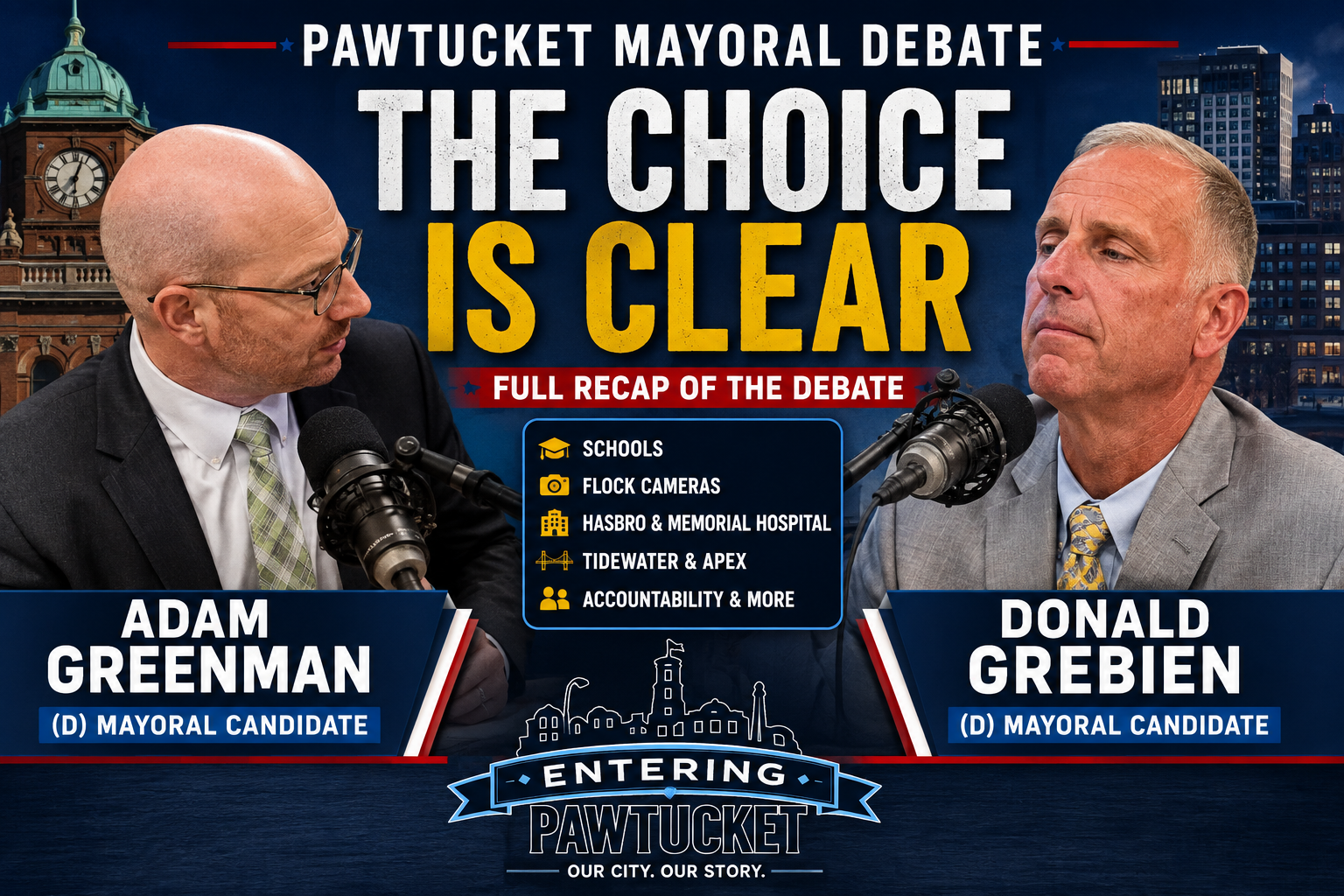
Adam Greenman and longtime Pawtucket Mayor Donald Grebien faced off in a spirited debate on The Boston Globe’s Rhode Island Report, giving Democratic voters a clear contrast ahead of the upcoming primary.
Greenman turned those 16 years into one of his central arguments for change.
He described a “tale of two Pawtucket’s,” contrasting major development with what he says residents continue to experience in their neighborhoods: struggling schools, deteriorating sidewalks, rats, speeding, public-safety concerns and increasing difficulty affording to live in the city.
Throughout the discussion, Grebien repeatedly pointed to his 16 years of experience, Pawtucket's improved financial condition and major development projects as reasons voters should keep him in office.
School Committee
Greenman was unequivocal in his opposition to taking elected School Committee representation away from voters.
Rather than supporting appointed members, Greenman suggested examining whether a ward-based system could give Pawtucket neighborhoods more direct representation, with voters ultimately deciding any change.
Grebien acknowledged concerns about how the recent hybrid proposal was rushed but maintained that changes to the School Committee structure should remain on the table.
Flock Cameras
One of Greenman's clearest proposals came during the heated discussion over Pawtucket's Flock license plate reading cameras.
Greenman said he would order a review on his first day as mayor, examining the cameras' effectiveness and exactly who receives their data. He pledged that within his first 100 days, his administration would decide whether the cameras should be removed or remain with significant restrictions on data sharing.
Grebien strongly defended the cameras, saying they have helped law enforcement and declaring, “They're not going anywhere.”
Hasbro and Memorial Hospital
Greenman repeatedly pressed Grebien on major Pawtucket properties that have either been lost or remained vacant during his tenure, including Hasbro, Memorial Hospital and Apex.
On the departing Hasbro headquarters, Greenman discussed potential light manufacturing, coworking space and a food hall. Grebien said his administration and state officials have already been working to identify potential future uses, including manufacturing or housing.
At Memorial Hospital, Greenman argued that the deteriorated former hospital should come down and proposed redeveloping the property with housing, including townhomes geared toward first-time homebuyers.
Grebien defended the redevelopment currently underway, pointing to years of state restrictions and plans involving residential, affordable and veterans housing, medical uses and retail.
Greenman Challenges Grebien on Accountability
Perhaps Greenman's strongest moment came during their exchange over who bears responsibility when major institutions leave or projects stall.
As Grebien explained the roles played by the state, private property owners and corporate leadership, Greenman argued that after 16 years the mayor also has to accept responsibility for outcomes.
“Good leaders understand that they share the credit and they own the blame,” Greenman said.
Grebien pushed back, calling the argument political “spin” and saying experience means understanding the limits of a mayor's authority and building the relationships necessary to navigate those obstacles.
A Clear Choice
The debate reinforced many of the reasons Entering Pawtucket endorsed Adam Greenman.
Grebien's case is largely one of experience and continuity. He points to Pawtucket's improved finances, new development and investment as evidence that his administration's work is paying off.
Greenman's case is that after 16 years, Pawtucket should expect more. Particularly when it comes to schools, affordability, neighborhood quality of life, transparency and accountability.
And importantly, Greenman didn't simply criticize. Throughout the debate he offered specific ideas for how he would approach several of the challenges facing Pawtucket.
For voters deciding whether Pawtucket should continue on its current path or take a different approach at City Hall, this debate made that choice considerably clearer.