

Pawtucket City Council Rejects Teachers’ Contract in 5–3 Vote
November 25, 2026 | Entering Pawtucket
The Pawtucket City Council voted 5–3 Tuesday night to reject a proposed three-year teachers’ contract following hours of public testimony and debate over educator compensation, school funding, and the city’s ability to afford the agreement.
The proposed contract between the Pawtucket School Committee and the Pawtucket Teachers Alliance covered September 1, 2026, through August 31, 2029. Teachers had ratified the agreement, and the School Committee had unanimously approved it before it reached the council.
The November 24 meeting exposed a sharp divide over whether the city should approve the negotiated agreement and address the funding challenges ahead, or require a clearer financial plan before committing to all three years.
Supporters: Honor the Agreement and Invest in Educators
Teachers, residents, and other supporters urged the council to approve the contract, describing it as an investment in both educators and students.
Speakers outlined the demands of teaching, including purchasing classroom supplies, working beyond school hours, and supporting children with increasingly complex needs. Several recalled previous salary freezes and concessions, arguing that educators had already helped the city through difficult financial periods.
Supporters also emphasized provisions beyond compensation. Speakers described additional elementary instructional time, smaller class sizes, and special education class-size protections as benefits that would improve conditions for students and teachers.
Mayor Donald Grebien spoke in favor of approval. He argued that protecting taxpayers and supporting educators were compatible responsibilities and urged the council to honor an agreement reached through collective bargaining.
Other supporters questioned the city’s spending priorities. They pointed to investments in school buildings and development projects, arguing that Pawtucket must also invest in the people working inside its classrooms.
Council members supporting the agreement acknowledged the financial risks but emphasized fair compensation, teacher recruitment and retention, and the consequences of continued underinvestment in education.
Opponents: A Three-Year Commitment Requires a Sustainable Funding Plan
Council members opposing the agreement repeatedly said their concerns centered on affordability, particularly in the second and third years.
They argued that the financial information presented during committee review did not provide sufficient confidence that the district could sustain the agreement throughout its full term.
Among the concerns discussed were the use of medical reserves to help cover expenses, rising health insurance costs, additional longevity benefits, and the possibility that recurring obligations could eventually require higher taxes, staffing reductions, or cuts elsewhere.
Opponents also questioned whether savings associated with potential school consolidation, redistricting, or other operational changes could be achieved in time. They argued that anticipated savings should not be treated as secured funding before the necessary decisions had been made.
Finance Committee Chairman Mark Wildenhain discussed an earlier suggestion to move forward with first-year compensation while the remaining years were addressed. According to the discussion, the union sought consideration of the original three-year agreement.
Several council members said they would reconsider their positions if presented with a credible plan to fund the entire contract.
Preliminary State-Aid Warning Adds to Concerns
A potential reduction in state education aid became a significant part of the debate.
Superintendent Randy Buck reported that preliminary projections discussed with Rhode Island Department of Education officials indicated Pawtucket could face a $10 million to $15 million reduction in state education aid for fiscal year 2028.
Buck stressed that the projections were preliminary. He identified declining enrollment, changes in poverty calculations, and adjustments to the state funding formula as factors discussed.
He said he had believed there was a financial pathway to support the agreement through difficult decisions, but the newly reported projections significantly complicated that approach. He also warned that a reduction of that magnitude could affect existing programs, services, staffing, and district operations beyond the contract itself.
Supporters of approval argued that uncertain projections required planning and advocacy for additional funding. Opponents said the warning strengthened their concerns about committing to expenses without a sustainable funding plan.
How Each Council Member Voted
The motion before the council was to deny the contract. A “Yes” vote supported rejection; a “No” vote opposed rejection and supported the contract.
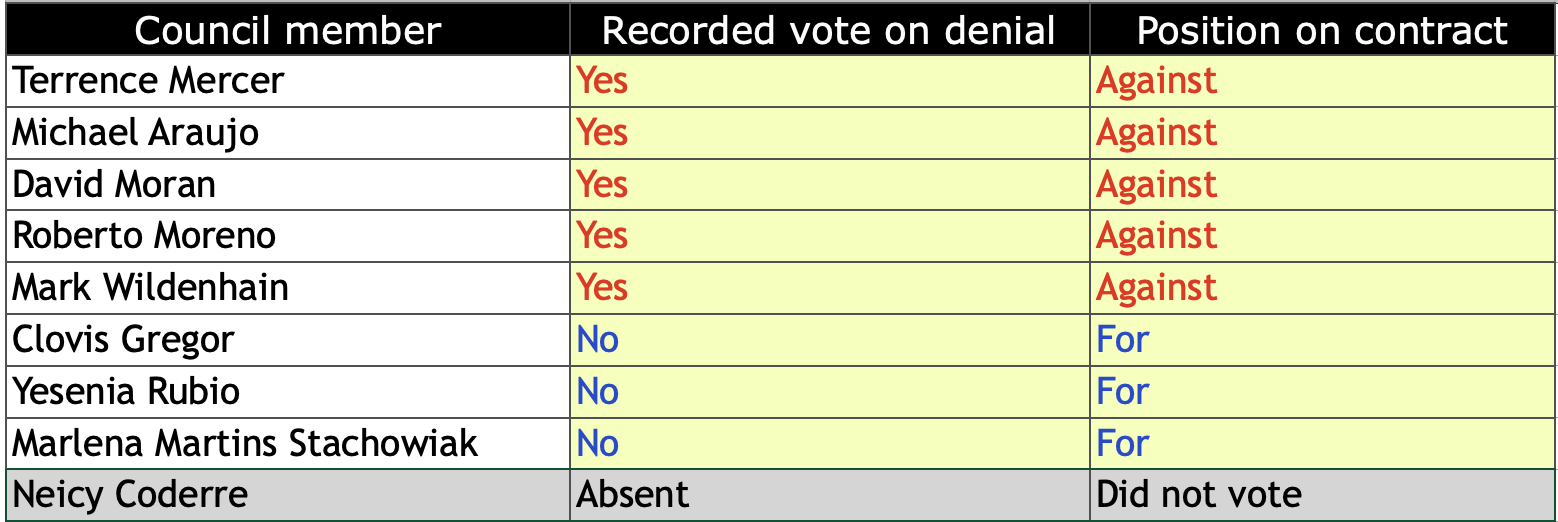
The motion to deny passed 5–3, rejecting the proposed agreement.
The decision leaves unresolved how the district, union, and city will reach an agreement that addresses educator compensation while meeting the financial concerns raised during the meeting. No replacement agreement was approved Tuesday night.